36
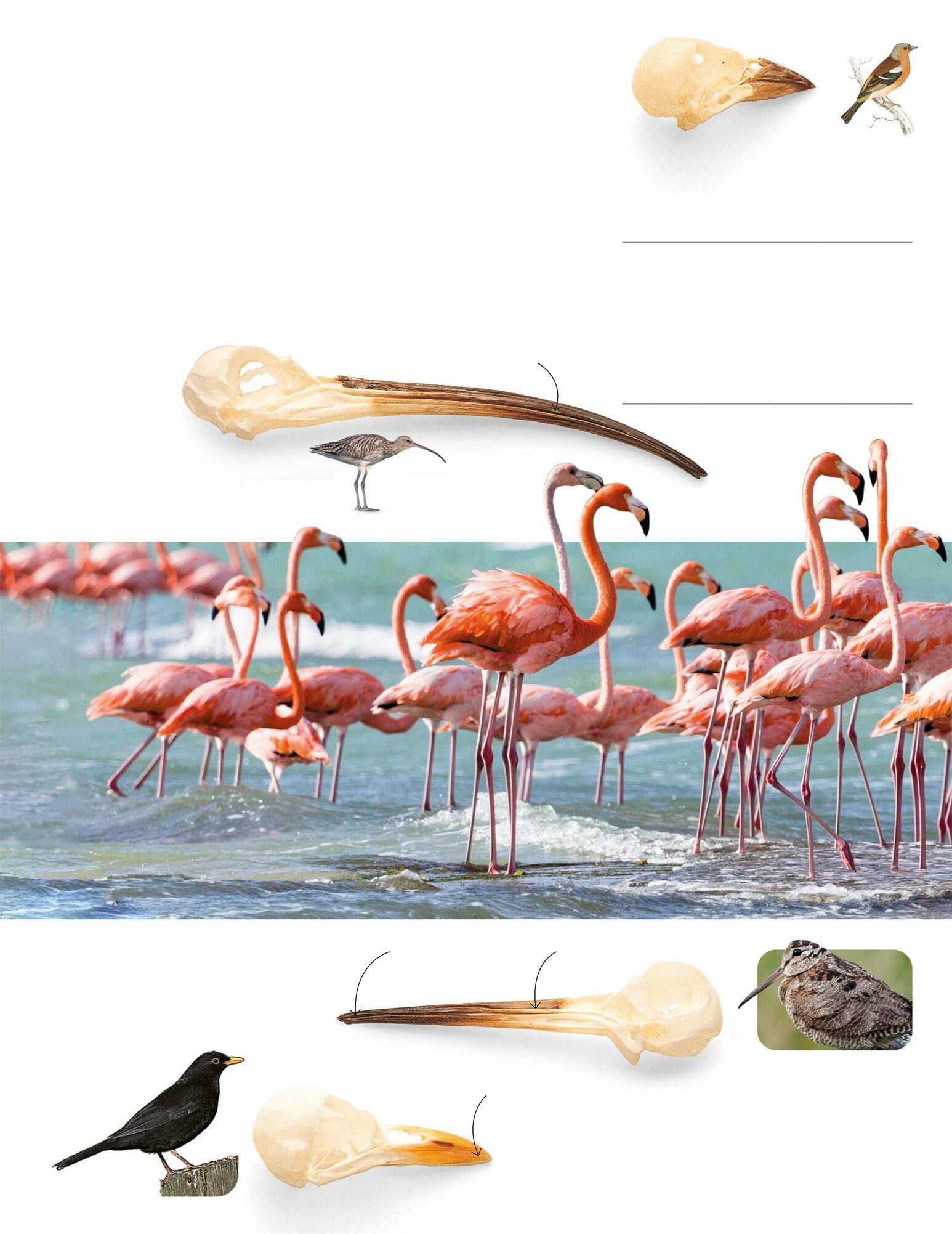
Beaks
As their front limbs are completely adapted for flight,
most birds hold their food with their beaks alone. Birds’
beaks have evolved a variety of shapes to tackle different
kinds of food. Some are short and straight for probing,
while others are long and curved for picking out food.
Seed-cracker
Birds such as chaffinches, which live on
hard seeds, have short cone-shaped
beaks to crack open their food.
For marshes and woodland
The woodcock uses its long, pointed
beak to extract earthworms and
insect larvae from damp ground.
A tweezer beak
The blackbird’s long, pointed
beak enables it to pick up small
seeds and grasp larger food
items such as earthworms.
The curlew’s
forceps
The curlew jabs
its long beak into
soft mud to pull
out worms and
molluscs that are
beyond the reach
of other birds.
Sensitive tip for
detecting worms
in ground
Long beak
Curled, long beak
Pointed beak for
grasping seeds
and larger food
A
woodpecker’s
beak
is
strong
enough for
hammering
, and its
tip can
repair itself
.
Chaffinch
Curlew
Blackbird
Woodcock